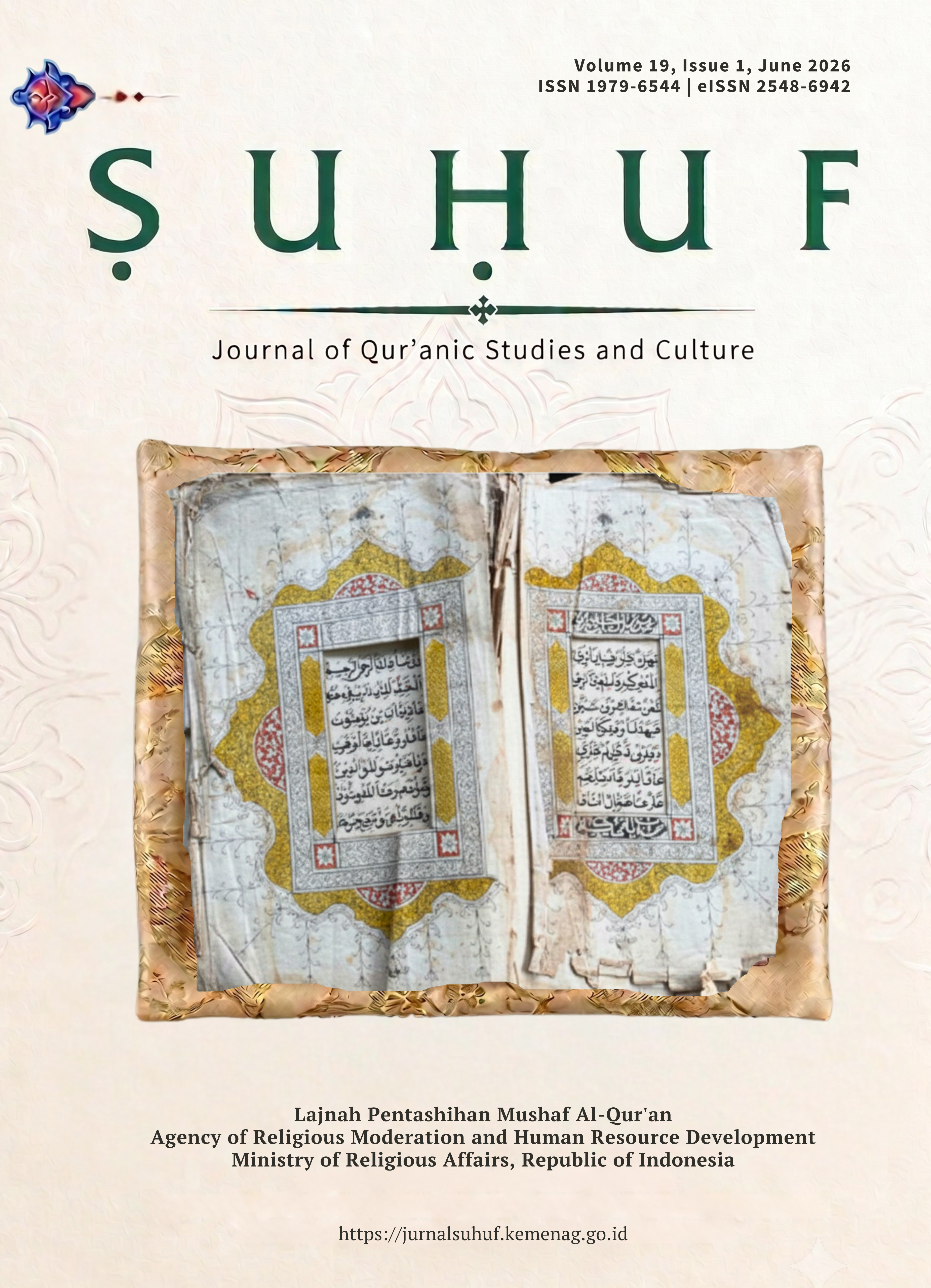
Beyond Passive Copying
Orthographic Fluidity and Intellectual Agency in Al-Banjari’s 18th-Century Quranic Manuscript
Abstract
The writing of the Qur’an mushaf in the archipelago shows a diversity of orthography that reflects the dynamics of the local Islamic scientific tradition, especially in the 18th century. One of the important manuscripts from this period is the Mushaf Al-Qur'an by Sheikh Muhammad Arsyad Al-Banjari, a prominent scholar from South Kalimantan. This article aims to examine the orthographic characteristics of the Qur'an in the manuscript and examine its degree of conformity with the rules of rasm ‘Usmaniy. This study uses a qualitative approach with philological methods, through a descriptive analysis of the forms of writing the Qur’an which include the rules of ḥazf, ziyadah, badal, as well as fasl and wasl. The results of the study show that in general this mushaf shows a tendency to follow rasm ‘Usmaniy, but in some parts there are orthographic variations influenced by the rules of rasm imla’iy and local writing practices. These variations not only reflect the flexibility in the tradition of copying mushaf in the archipelago, but also show the scientific authority of copyists in adapting the rules of writing to the local context. These findings confirm that the 18th-century Nusantara mushaf cannot be understood solely as a passive copy of Middle Eastern standards, but rather as an intellectual product that lives in the local cultural and scientific space.
Downloads
Copyright (c) 2026 Aulia Raudhatul Jannah, Eva Nugraha, Basyir Arif

This work is licensed under a Creative Commons Attribution-ShareAlike 4.0 International License.

© Copyright CC BY-SA