Ottoman-Style in the Qur’anic Manuscript Copied by Sayyid Muhammad Nayazi in Bantul D.I. Yogyakarta
A Codicological and Textological Study
Abstract
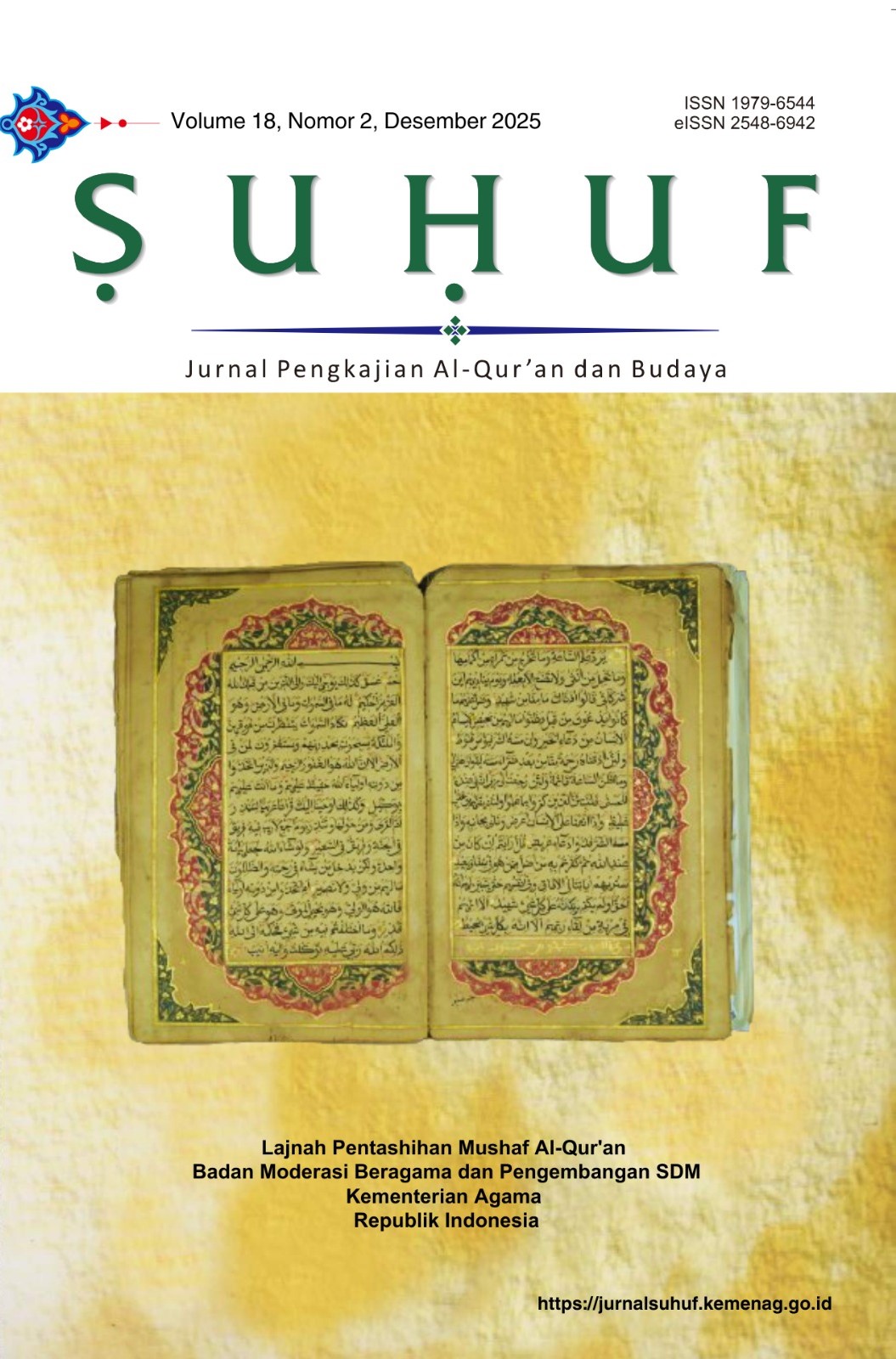
This article examines the Qur’anic manuscript copied by Sayyid Muhammad Nayazi, discovered in Imogiri (Bantul), complete in 30 juz and dated 1277 AH (c. 1860–1861 CE). It aims to identify measurable “Ottoman-style” indicators through codicological–textological evidence and comparison. The study employs a qualitative design combining library and field research, using manuscript documentation, interviews with the owner/family, and a philological approach (codicology and textology). The findings reveal a consistent cluster of indicators: the 20-pages-per-juz rhythm (with limited variations), the ayet ber kenar (corner-verse layout), and the 15-lines-per-page standard, alongside an opening illumination (serlevha), functional script distribution (naskhiy–sulus–riq‘ah), and a reading apparatus (predominantly imla’iy rasm with traces of ‘usmaniy features, dabt markers, tajwid–waqf signs, scholia, and qira’at notes). These features support the conclusion that the Nayazi mushaf follows an Ottoman-oriented production model designed for stable reading and memorization practices. However, geographic provenance still requires further internal evidence, such as ownership seals or waqf notes. This study adds to the mapping of Ottoman-style mushafs in Java and proposes a comparative indicator set for similar manuscript studies.
Downloads
Copyright (c) 2025 Ayu Nadhifah, Fariha Nuril Hajar Al Adha

This work is licensed under a Creative Commons Attribution-ShareAlike 4.0 International License.

© Copyright CC BY-SA